Standards & Specifications
AGMA 9002 vs DIN 3761/5480 vs IS 3238: which standard governs your coupling?
Only two of these three documents govern a whole coupling. The third governs a seal and a spline. Treating it as a three-way choice is how a drawing ends up citing all three and satisfying none of them cleanly.
- Author
- Priyansh Thummar, Editor
- Dates
- Published · Last updated
- Reading time
- 4 minutes
1. Scope of each document
AGMA 9002 is a bore-and-fit practice: inch-series bore tolerances, keyway dimensions and interference-fit practice for flexible couplings in general industrial service. It governs the shaft-hub interface of the whole coupling and nothing else.
DIN 3761 and DIN 5480 are component standards, not coupling standards. DIN 3761 specifies radial shaft seals — the lip seal that retains grease and excludes contamination at a lubricated coupling's sleeve joint. DIN 5480 specifies involute splined connections, an alternative to a keyed bore at the shaft-hub interface. Neither document addresses torque rating, balance, or the coupling as an assembly.
IS 3238 is the Indian domestic standard covering gear couplings as a complete product, published by the Bureau of Indian Standards. In role it sits closer to AGMA 9002 than to either DIN document, because it addresses the coupling itself rather than a single component of it.
1.1 Shaft-hub interface
AGMA 9002 and IS 3238 genuinely compete here. AGMA 9002 works in inch clearance-fit classes with a parallel key across most industrial sizes. IS 3238 works in the ISO metric system, typically an H7 shaft bore with a parallel key — a different tolerance grammar, not a stricter or looser version of the same one. DIN 5480 offers a third option at this interface entirely: a splined connection engaging multiple teeth around the bore, generally specified where torque density in a limited bore diameter matters more than ease of disassembly.
1.2 Sealing practice
Sealing is DIN 3761's actual subject, and neither AGMA 9002 nor IS 3238 addresses it in comparable depth. A coupling built to either bore standard still needs a seal at the sleeve joint if it is grease-lubricated, and DIN 3761 is the document most commonly cited for that seal's dimensions and lip material — independently of which standard governs the bore.
2. Clause comparison
| Aspect | AGMA 9002 | DIN 3761 / DIN 5480 | IS 3238 |
|---|---|---|---|
| Primary subject | Bore & keyway dimensions | Shaft seal (3761) / splined interface (5480) | Gear coupling design & dimensions |
| Governs whole coupling? | Yes — bore/fit only | No — component-level only | Yes |
| Shaft-hub interface | Keyed, inch clearance fit | Splined (5480), where specified | Keyed, ISO metric fit |
| Sealing | Not specified | Radial lip seal practice (3761) | Not detailed in standard |
| Rating / service factor | Application-class factor | Not addressed | Application-class factor (typical) |
| Primary market | General export catalogue | Referenced alongside any market | Domestic Indian supply |
3. Rating and service factor
AGMA catalogue ratings carry an implied service factor for the application class, looked up once. IS 3238 practice is understood to follow a broadly similar application-class approach, calibrated to driver types common on Indian sites — induction motors and diesel gensets — though the exact factor tables should be confirmed against the current published edition rather than assumed. Citing DIN 3761 or DIN 5480 contributes nothing to the torque rating: that figure still has to come from whichever whole-coupling standard, or manufacturer catalogue, actually governs the assembly.
3.1 Selection torque
Tsel = (9550 · Prated / n) × Kf × Kt
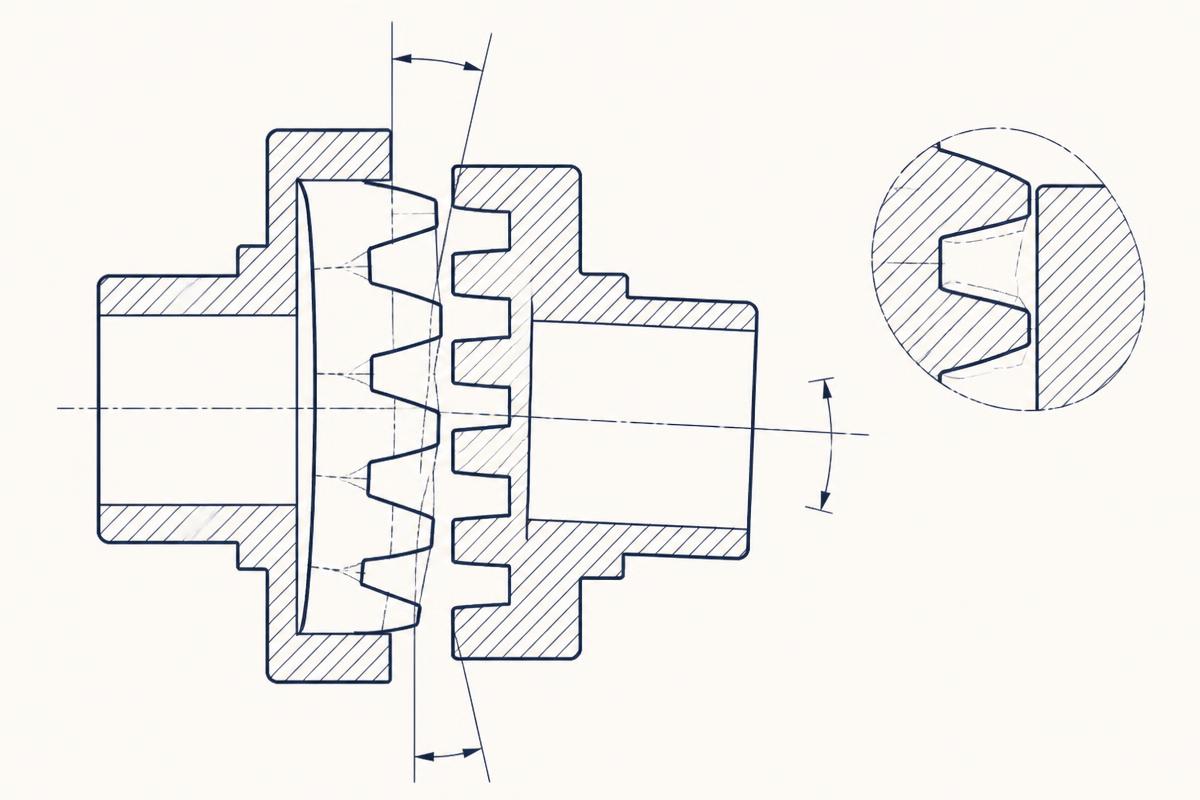
3.2 Tooth geometry under misalignment
Tooth geometry is common to any gear coupling regardless of which standards are cited, because it is a property of the crowned-tooth mechanism itself. Crowned external teeth accommodate angular misalignment by rolling the contact point along the crown as the shaft rotates. Sliding velocity at the tooth flank, not transmitted torque, usually sets the practical misalignment limit: above roughly 1.5° per mesh the lubricant film becomes difficult to maintain and wear turns progressive rather than run-in.
4. Deciding which applies
Deciding is two separate questions, not one three-way choice.
| Question | Options | Decided by |
|---|---|---|
| Which standard governs bore, fit and rating? | AGMA 9002 / IS 3238 / named purchaser spec | Export market vs. domestic Indian supply |
| What shaft-hub interface is used? | Keyed bore (AGMA/IS) / splined (DIN 5480) | Torque density and disassembly frequency |
| What seal is specified? | DIN 3761 lip seal / manufacturer's standard practice | Lubrication method and contamination risk |
Frequently asked
- Is AGMA 9002, DIN 3761 or IS 3238 the right standard for my coupling?
- The question contains a false premise: they are not three versions of the same document. AGMA 9002 governs the bore and fit of the shaft-hub interface. IS 3238 governs a gear coupling as a complete product. DIN 3761 governs a radial shaft seal and DIN 5480 governs an involute spline — components a coupling happens to contain. A drawing can legitimately cite AGMA 9002 or IS 3238 alongside both DIN documents without contradiction, because they answer different questions.
- Can a coupling specified to AGMA 9002 be supplied against IS 3238 instead?
- Not by substitution, because the two use different tolerance grammars at the shaft interface. AGMA 9002 works in inch-series clearance-fit classes; IS 3238 works in the ISO metric system. Converting between them by rounding a dimension is the most common way a bore mismatch reaches site. If a change of governing document is needed, the bore and keyway are re-specified in the new system rather than translated.
- Which document should a purchase order name?
- The one that governs the thing being bought. Name the whole-coupling standard the coupling is to be manufactured to, then name the interface standard the bore and keyway are to be machined to, and name the seal or spline standard only if you are specifying that component. Citing all three as though they were alternatives is what produces a drawing that satisfies none of them cleanly.
- Do any of these standards fix the coupling's torque rating?
- No. Rating depends on tooth geometry, material and heat treatment, and it is published by the manufacturer for its own range. The standards named here govern dimensions, fits, components and — in the case of IS 3238 — the product and its documentation. A specification that names a standard but no required torque, speed and misalignment has not specified a coupling.
References
- AGMA 9002-B04, Bores and Keyways for Flexible Couplings (Inch Series). American Gear Manufacturers Association.
- DIN 3761, Radial shaft seals for rotary applications. Deutsches Institut für Normung.
- DIN 5480, Splined connections with involute splines based on reference diameters. Deutsches Institut für Normung.
- IS 3238, Specification for flexible couplings — gear type. Bureau of Indian Standards. Designation confirmed against the client's content plan; clause references are illustrative pending purchase and verification of the current published edition.
- AGMA 9008-B00, Flexible Couplings — Gear Type — Flange Dimensions, Inch Series.
Related articles
Standards
AGMA 9002: bores and keyways for flexible couplings
The inch-series bore and keyway practice this comparison measures the others against.
Standards
IS 3238: the Indian standard for gear couplings
The domestic whole-coupling standard, and what a BIS-referenced order expects on delivery.
Selection & Sizing
Misalignment capacity
Why the sliding velocity at the tooth flank, not transmitted torque, sets the practical limit.